Download PDF The Conceit of Humanitarian Intervention, by Rajan Menon
Those are several of the benefits to take when obtaining this The Conceit Of Humanitarian Intervention, By Rajan Menon by on-line. However, exactly how is the method to get the soft file? It's very appropriate for you to visit this web page considering that you can obtain the web link page to download the publication The Conceit Of Humanitarian Intervention, By Rajan Menon Merely click the web link offered in this write-up as well as goes downloading. It will not take significantly time to obtain this book The Conceit Of Humanitarian Intervention, By Rajan Menon, like when you need to choose book store.
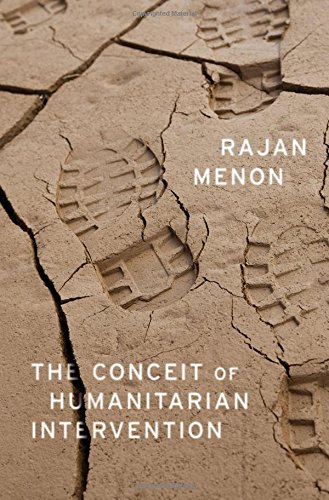
The Conceit of Humanitarian Intervention, by Rajan Menon

Download PDF The Conceit of Humanitarian Intervention, by Rajan Menon
The Conceit Of Humanitarian Intervention, By Rajan Menon. Provide us 5 mins and we will certainly reveal you the most effective book to review today. This is it, the The Conceit Of Humanitarian Intervention, By Rajan Menon that will be your ideal choice for much better reading book. Your 5 times will certainly not spend wasted by reading this site. You can take the book as a resource to make far better principle. Referring the books The Conceit Of Humanitarian Intervention, By Rajan Menon that can be located with your requirements is sometime tough. Yet below, this is so simple. You can discover the very best point of book The Conceit Of Humanitarian Intervention, By Rajan Menon that you can read.
To get over the problem, we now offer you the technology to purchase the publication The Conceit Of Humanitarian Intervention, By Rajan Menon not in a thick published documents. Yeah, checking out The Conceit Of Humanitarian Intervention, By Rajan Menon by on-line or obtaining the soft-file only to check out could be among the means to do. You may not really feel that checking out an e-book The Conceit Of Humanitarian Intervention, By Rajan Menon will certainly serve for you. However, in some terms, May people effective are those that have reading behavior, included this kind of this The Conceit Of Humanitarian Intervention, By Rajan Menon
By soft documents of the publication The Conceit Of Humanitarian Intervention, By Rajan Menon to check out, you could not need to bring the thick prints everywhere you go. Whenever you have going to check out The Conceit Of Humanitarian Intervention, By Rajan Menon, you can open your device to review this publication The Conceit Of Humanitarian Intervention, By Rajan Menon in soft documents system. So easy as well as quick! Reading the soft documents e-book The Conceit Of Humanitarian Intervention, By Rajan Menon will certainly give you very easy means to check out. It could likewise be faster because you can read your book The Conceit Of Humanitarian Intervention, By Rajan Menon everywhere you want. This on the internet The Conceit Of Humanitarian Intervention, By Rajan Menon could be a referred book that you can enjoy the solution of life.
Because e-book The Conceit Of Humanitarian Intervention, By Rajan Menon has great benefits to read, numerous individuals now increase to have reading behavior. Supported by the developed modern technology, nowadays, it is easy to obtain guide The Conceit Of Humanitarian Intervention, By Rajan Menon Also guide is not alreadied existing yet out there, you to look for in this site. As what you could find of this The Conceit Of Humanitarian Intervention, By Rajan Menon It will really reduce you to be the first one reading this publication The Conceit Of Humanitarian Intervention, By Rajan Menon and also get the perks.
With the end of the Cold War has come an upsurge in humanitarian interventions-military campaigns aimed at ending mass atrocities. These wars of rescue, waged in the name of ostensibly universal norms of human rights and legal principles, rest on the premise that a genuine "international community" has begun to emerge and has reached consensus on a procedure for eradicating mass killings. Rajan Menon argues that, in fact, humanitarian intervention remains deeply divisive as a concept and as a policy, and is flawed besides. The advocates of humanitarian intervention have produced a mountain of writings to support their claim that human rights precepts now exert an unprecedented influence on states' foreign policies and that we can therefore anticipate a comprehensive solution to mass atrocities.
In The Conceit of Humanitarian Intervention, Menon shows that this belief, while noble, is naïve. States continue to act principally based on what they regard at any given time as their national interests. Delivering strangers from oppression ranks low on their list of priorities. Indeed, even democratic states routinely embrace governments that trample the human rights values on which the humanitarian intervention enterprise rests.
States' ethical commitment to waging war to end atrocities remains episodic and erratic-more rhetorical than real. And when these missions are undertaken, the strategies and means used invariably produce perverse, even dangerous results. This, in no small measure, stems from the hubris of leaders-and the acolytes of humanitarian intervention-who have come to believe that they possesses the wisdom and wherewithal to bestow freedom and stability upon societies about which they know little.
- Sales Rank: #777158 in Books
- Brand: Rajan Menon
- Published on: 2016-03-03
- Original language: English
- Number of items: 1
- Dimensions: 5.90" h x 1.20" w x 8.60" l, .0 pounds
- Binding: Hardcover
- 256 pages
- The Conceit of Humanitarian Intervention
Review
"Menon brilliantly explicates the several fallacies of the interventionists, while at the same time keeping the door open for intervention in reaction to atrocities when geopolitical
forces are effectively aligned and the likely costs realistically taken into account." -- ID: International Dialogue, A Multidisciplinary Journal of World Affairs
"Menon's main point is that states have not changed their foreign policies since the Cold War. The primary determinant, he says, is whether intervention serves the states' interests. This explains, for instance, why the US intervened in Kosovo but not Syria. Although not a scholarly analysis of humanitarian intervention, the book is recommended as an accessible introduction to an important international relations issue." -- R. P. Peters, Univ. of Massachusetts / Harvard Univ. Davis Center, CHOICE
"Menon has written a very smart book that shows the difficulty of getting countries to engage in humanitarian interventions, much less do them right. He also makes clear that the advocates of intervention do not lack for hubris, but do lack an understanding of the limits of the enterprise. Sadly, this sobering book leaves us with little hope that the so-called international community can do much to prevent the mass slaughter of innocent people."
--John J. Mearsheimer, R. Wendell Harrison Distinguished Service Professor of Political Science, University of Chicago
"It's hard to imagine a more complete demolition of the idea that there is, or should be, a legal norm in favor of humanitarian military intervention to stop atrocities. The only relevant law is, as Menon demonstrates, the law of unintended consequences."
--Eric Posner, Kirkland and Ellis Distinguished Service Professor of Law and Arthur and Esther Kane Research Chair, University of Chicago
"This is an immensely admirable book - concise, lucid, and above all tough-minded. Proponents of humanitarian intervention will find Rajan Menon's stinging critique discomfiting - which is precisely why it merits their considered attention."
--Andrew J. Bacevich, Professor Emeritus of History and International Relations, Boston University
"There is such a thing as a problem - even a "problem from hell" - to which there is no solution. In showing that outrage against bloody atrocity almost never justifies a military response, Rajan Menon achieves the best available critique of humanitarian intervention ever written. Careful, dispassionate, and methodical, The Conceit of Intervention is most of all a debate with those who would wish away tragedy - especially the tragedy of lacking solutions, even when the problem is compelling - in the persistently self-interested domain of international affairs. A must-read."
--Samuel Moyn, Professor of Law and History, Harvard University
"Richly documented and persuasive...The Conceit of Humanitarian Intervention is an excellent guide for policy-makers, and for anyone participating in the policy discussion, the next time a situation arises in which talk begins about using military force to save lives."
--Paul R. Pillar, LobeLog
"[This] book serves as a sharp shot across the bow to those who urge the further entrenchment of - and who believe in the inevitability of - a deep, consistent policy of humanitarian intervention in all situations of mass atrocities."
--New Rambler Review
About the Author
Rajan Menon is the Anne and Bernard Spitzer Professor of Political Science, City College of New York/City University of New York, and a Senior Research Scholar, Saltzman Institute of War and Peace Studies, Columbia University. His most recent book, co-authored with Eugene B. Rumer, is Conflict in Ukraine: The Unwinding of the Post-Cold War Order (MIT Press, 2015). His most recent book for Oxford University Press, The End of Alliances, was published in 2007 and was named by the American Library Association as an Outstanding Academic Title for that year.
Most helpful customer reviews
7 of 7 people found the following review helpful.
An important new critique of ideological thinking in US foreign policy
By Graham E. Fuller
Rajan Menon’s new book, “The Conceit of Humanitarian Intervention,” launches a timely and compelling argument against a dominant line of thought lying behind so much of modern American foreign policy—“humanitarian intervention” or “liberal interventionism.” We are, of course, well familiar with Republican and neocon readiness to go to war, but the reality is that many Democrat Party leaders have been no less seduced into a series of optional foreign military interventions, with increasingly disastrous consequences. Hillary Clinton is today one of the leading exponents of the idea, but so are many of the advisors around President Obama.
Menon’s book constitutes essential reading for anyone troubled by the ugly character of so much of the international scene these days, and yet dismayed by its exploitation by policy-makers who cloak invasion, power projections and military operations in the garb of humanitarian effort. Here is a cogent critique of the recent decades of US foreign policy misadventures in which our military has become the primary instrument of US policy—and justified in the name of humanitarian goals. We rarely get to hear these arguments so clearly presented.
In rejecting the premise of “liberal interventionism” Menon is not exercising some hard-minded, bloodless vision of policy—quite the opposite. He is deeply concerned for the wellbeing of peoples and societies abroad—who are often among the primary victims of such liberal interventionism. He argues not as an isolationist but rather as an observer who has watched so many seemingly well-minded interventions turn into horror stories for the citizens involved.
The title of the book, “The Conceit of Humanitarian Intervention,” suggests that at the very least such policies are self-deceiving, in other cases perhaps deliberately meant to obfuscate. Menon here poses the question whether, for whatever motivation, great powers can ever sufficiently master the complexity of foreign societies to truly engineer a better life in the countries we target for remodeling. And whether we can afford to undertake an enterprise that requires deep hands-on involvement and might take decades to achieve— at the least.
Any reader of the book is eventually forced to confront a deeper question: when is war in fact “worth it”? Few would respond “never,” but many might respond “rarely.” Yet Menon is not arguing against war as such, so much as forcing us to acknowledge the faulty “liberal” foundation of our relentless quest for enemies to destroy—in the name of making the world a better place. An important and fresh insight into the policy confusions of our time.
5 of 5 people found the following review helpful.
Recognizing the limitations of humanitarian intervention
By Paul Mastin
When a people group is being oppressed or is suffering persecution or even genocide, the global community sometimes calls for humanitarian intervention. But what are the limits? What are the guidelines? Is it even practical, possible, or effective? In The Conceit of Humanitarian Intervention, City College of New York professor Rajan Menon argues that "the terms of peace and justice proffered by humanitarian interventionists withstand neither ethical nor practical scrutiny."
Menon reviews instances of humanitarian intervention (and lack thereof) in the late 20th and 21st centuries, including in Libya, Grenada, Kosovo, Bosnia, Iraq, and elsewhere. Those who call for humanitarian intervention claim a "commitment to transnational moral responsibility, human rights, and justice," yet Menon is cynical about the purity of the motives, at least in practice. The inconsistency with which the principals of intervention are applied show the poverty of the argument.
The doctrine of "responsibility to protect" (R2P) provides cover for a wide array of government interventions, but "despite its egalitarian allure and homage to justice, in practice R2P will simply reinforce existing hierarchies." Menon cynically dismisses much intervention as self-serving: "Governments will engage in humanitarian intervention when it serves their interests or when the price that they expect to pay is tolerable."
Even the International Criminal Court has proven ineffective, or at least severely limited. The countries who agree to its terms don't really need it, and the countries that need to be policed don't agree to it, and it is subject to political biases. "The presentation of the ICC as a neutral organization--above politics, guided only by law and the pursuit of justice--does not withstand scrutiny." Although there have been plenty of opportunities, "the ICC has yet to bring to justice any top leaders connected to atrocities."
Menon recognizes the importance of humanitarian intervention. If today there are not innocents being slaughters, governments treating their people unjustly, atrocities and genocide, just give it time. Great evil is committed around the world, almost continually, by governments and quasi government groups. Menon is not satisfied with the ICC, R2P, and the current state of humanitarian interventions. He does not, unfortunately, offer much in the way of a solution, other than to recognize the state of things. Perhaps that is his next book. For now, perhaps his harsh, cynical assessment will jostle decision makers toward change.
Thanks to NetGalley and the publisher for the complimentary electronic review copy!
2 of 2 people found the following review helpful.
Finely researched, honest, and hard-hitting – can make a great textbook
By Olena Lennon
With a historian’s scrupulousness, Menon draws on lessons of humanitarian interventions -- from the Ottoman Empire to East Pakistan, Cambodia, Rwanda, Kosovo, Bosnia, Darfur, and Syria -- to call into question “cosmopolitan sentiment” and “ethical commitment” often used to justify such interventions.
Menon shrewdly exposes the hypocrisy of humanitarian interventions by showing that states only intervene to save people in other countries with their practical goals in mind; and if such intervention would compromise national (read: economic) interest, they would, at best, issue a public condemnation of mass murder. To that end, Menon cautions against selective use of humanitarian interventions, lest they create opposite effect: mistrust and cynicism of “rescued” people, and worse yet, increased violence by the perpetrators.
To further prove his point, Mennon provides numerous examples when advanced democracies turned a blind eye to the atrocities committed in other countries, and continued to do business with – and openly support – dictators, who under different circumstances (read: in weaker countries) would have been good targets for deposition and invocation of R2P.
Make no mistake – this book is NOT against humanitarian interventions as a way for the concerned international community to stop mass-killings and protect human rights. Instead, Menon urges the interventionists and cosmopolitans to carefully consider the price innocents pay from unintended (and ill-intended) consequences of such humanitarian pursuits, and put their money where their mouths are – if they are indeed concerned with the preservation of human lives in other countries, deeper commitment and allocation of all necessary resources should follow.
This book is highly relevant for policy-makers, NGOs, government officials, academics, political activists, students, and other responsible citizens.
You won’t find any conspiracy theories, rumors, or hidden agendas here – it is a sensible analysis of historical facts, presented in the clear, concise, and engaging manner.
The Conceit of Humanitarian Intervention, by Rajan Menon PDF
The Conceit of Humanitarian Intervention, by Rajan Menon EPub
The Conceit of Humanitarian Intervention, by Rajan Menon Doc
The Conceit of Humanitarian Intervention, by Rajan Menon iBooks
The Conceit of Humanitarian Intervention, by Rajan Menon rtf
The Conceit of Humanitarian Intervention, by Rajan Menon Mobipocket
The Conceit of Humanitarian Intervention, by Rajan Menon Kindle

Tidak ada komentar:
Posting Komentar